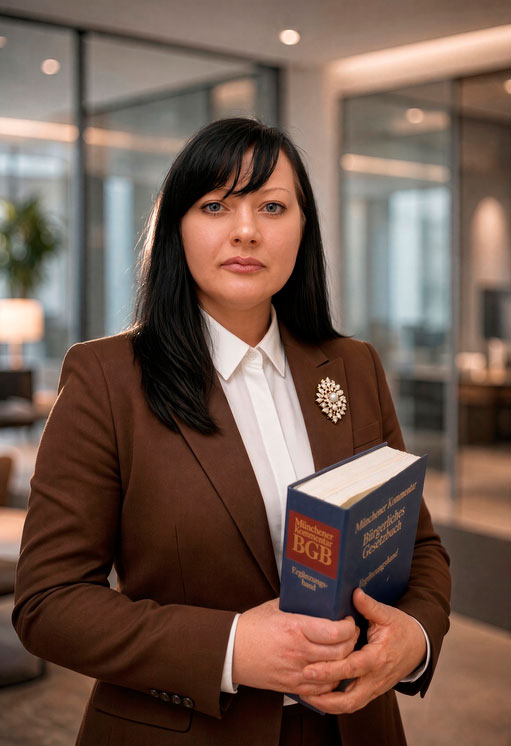
“An inheritance is the helping hand
that parents reach out to their children from the grave.”
Berliner Testament
Under a joint will of spouses (Berliner Testament, § 2269 BGB), the surviving spouse usually first becomes the sole heir, while the children inherit only after the survivor's death — this can only be changed while both spouses are still alive.
Victor Hugo
Inheritance law (Erbrecht) in Germany is set out in Book Five of the German Civil Code (Bürgerliches Gesetzbuch, BGB). It governs the opening of succession (Erbfall) and the passing of the estate to the heirs, the disclaimer of an inheritance (Ausschlagung), the heirs' liability for the deceased's debts, the right to a compulsory share (Pflichtteil), the making and notarisation of wills, questions concerning the contract of inheritance (Erbvertrag), the grounds for unworthiness to inherit (Erbunwürdigkeit) and other matters of inheritance law. Court proceedings in probate matters are governed by the Act on Proceedings in Family Matters and in Matters of Non-contentious Jurisdiction (FamFG, §§ 342 et seq.), and notarisation by the Notarisation Act (BeurkG). In cross-border cases, jurisdiction and the applicable law are generally determined by the deceased's last habitual residence (Art. 4, 21 EU Succession Regulation, EuErbVO).
As we have explained in earlier articles, the estate passes to the heir automatically on death (§§ 1922, 1942 BGB); no separate acceptance is required. Succession is based either on the law (gesetzliche Erbfolge) or on a disposition mortis causa – a will or a contract of inheritance (§§ 1937, 1941 BGB). Statutory succession applies where there is no will or where the will does not dispose of the deceased's entire estate. Statutory heirs of the first order are the deceased's descendants (§ 1924 BGB); the surviving spouse has a separate statutory right of inheritance alongside them (§§ 1931, 1371 BGB). Grandchildren and great-grandchildren take the place of a parent who is no longer alive at the time of the deceased's death (§ 1924(3) BGB); the same applies if the parent has disclaimed the inheritance (§ 1953(2) BGB).
The “Berliner Testament” (§ 2269 BGB) is one of the most widespread forms of will – not least because it is simple and easy to understand. The spouses appoint each other as heirs, while a third party (usually their joint children) is appointed as final heir (Schlusserbe). After the death of the first spouse, the surviving spouse, in case of doubt, becomes full heir (Vollerbe); the third party becomes final heir only on the survivor's death (§ 2269(1) BGB, the so-called Einheitslösung). Prior and subsequent inheritance (Vor- und Nacherbschaft, §§ 2100 et seq. BGB, the so-called Trennungslösung) applies only if the spouses expressly provide for it. While both spouses are alive, a mutually dependent disposition can only be revoked by a notarised declaration to the other spouse (§§ 2271(1), 2296 BGB). On the death of the first spouse the right of revocation lapses; the survivor can then cancel his or her own mutually dependent dispositions only by disclaiming what he or she was given (§§ 2270, 2271(2) sentence 1 BGB).
Making a Berliner Testament does not exclude claims to the compulsory share (Pflichtteil): persons entitled to it (descendants, the spouse and in some cases parents) who are excluded from succession by a disposition mortis causa do not become heirs, but have a monetary claim for half of their statutory share (§§ 2303, 2317 BGB) – even if the entire estate has been left to others by will. The children can claim the compulsory share as early as the death of the first parent; this is why a Berliner Testament often contains a compulsory-share penalty clause (Pflichtteilsstrafklausel).
In the Russian Federation, for example, joint wills of spouses have only been permitted since 1 June 2019 (Art. 1118(4) Civil Code of the Russian Federation). Similar to mutual wills in English law, the Berliner Testament in German law allows spouses to dispose of their assets jointly in the event of death, so that everything passes to the surviving spouse, while at the same time protecting the dispositions of the first spouse to die from being altered or revoked by the survivor.
As they often say in America: “You can't live without lawyers – and you certainly can't die without them.”
Following this principle, the elderly parents of our client Nadezhda (name changed), who had spent their whole lives together in harmony, decided to make provision during their lifetime for the assets they had built up together. They therefore went to a notary and made a Berliner Testament. As the “third party” who was to inherit after the death of both parents, they appointed their daughter, then aged 20, who at the time was in her third year at a German university. After Nadezhda's mother died, the jointly acquired assets passed to her father (let us call him Viktor). By then Nadezhda already had a family of her own. She and her husband earned well, lived in a spacious flat, went on holiday several times a year and did not have to deny themselves anything. Nadezhda therefore took little interest in the assets left after her mother's death. She knew that her widowed father was living alone at first and did everything she could to ease his loneliness. The grown-up daughter visited him often, brought her children along, took him on long walks in the park and, twice a year or more, paid for spa stays (Kuraufenthalte) to restore his health, which had suffered after the death of his beloved wife. As the saying goes, time heals, and on one of these trips Viktor met 35-year-old Alla (name changed), with whom, after a short period of getting to know each other better, he decided to spend the rest of his life.
The relationship between Nadezhda and Alla was never warm. As Nadezhda had always believed that “a bad peace is better than a good quarrel”, she tried to keep relations on an even keel, avoided conflict and did not reproach her father about his private life – especially as he had never asked for her opinion. At the same time, the daughter could see that her father, although he was living with his new partner, still needed care. She continued to provide him with expensive medicines, paid for the necessary treatment in private clinics and financed spa stays for the new couple. At first all this was manageable for Nadezhda, as her family's income was enough to support her father and his young partner on a regular basis. Viktor's last years were fairly carefree; as far as his array of chronic illnesses allowed, he enjoyed life, and he died at the age of 83.
This is where things became interesting. Nadezhda knew that her parents had had a Berliner Testament notarised a few years before her mother's death, under which Nadezhda was the final heir after her father's death. She remembered clearly that after her mother's death a spacious two-room flat with a large kitchen and a balcony, together with substantial savings accumulated during the marriage, had passed into her father's sole ownership. When Nadezhda, as final heir under the will, sought to take over the estate, she discovered, to her great surprise, that in fact there was hardly anything left to inherit. It turned out that within two years of his wife's death the elderly father had given his new partner no less than €167,000. There were therefore no funds left in the deceased's bank account. In addition, he had formally granted Alla a lifelong right of residence (Wohnrecht) in the flat – the flat he had once bought with his wife, in which the two of them had spent almost their entire life together and in which their daughter Nadezhda had grown up. One might say it would be funny if it were not so sad. Nadezhda, who had no legal training but sensed intuitively that the actual situation was consistent neither with the logic of the law nor with common sense, wanted to get to the bottom of the matter and find out whether what had happened was lawful. She turned to our law firm to have the position under German law explained to her and to understand how she could proceed.
Our lawyer listened to the client and explained that it was first important to understand how the considerable sum of money had come into Alla's possession. The documents on Alla's account movements provided by the client made it clear that the amount of €167,000 had been transferred to the woman's account in five instalments on Viktor's instructions over a period of two years. The lawyer representing Nadezhda's interests then prepared a letter to Alla, the main demand of which was the repayment of the considerable sum of money given to her. It came as no surprise to anyone that Alla refused to return the “lawfully received gift”, arguing that she had received the money in return for “caring for the elderly man”. The only remaining way to restore justice and protect Nadezhda's legitimate interests was therefore to go to court. Nadezhda instructed us to represent her in these proceedings.
Alla's argument that the money had been paid to her as remuneration under a care agreement for Viktor did not convince the court that the “transaction” was lawful. Alla even brought a friend to the hearing as a witness, who was to testify that Alla had cared for the elderly man regularly and conscientiously. Once our lawyer began questioning the witness, she became increasingly entangled in contradictions. After several significant inconsistencies in her account had come to light, it became clear that the court did not believe her testimony. It was thus established that there had been no contractual relationship between Viktor and Alla, either formal or de facto, that Alla had not provided him with any care and had not concerned herself with improving Viktor's quality of life. The money had consequently been given to Alla purely as a gift.
Our lawyer then explained that, as full heir (Vollerbe), Viktor had in principle remained free to dispose of the assets during his lifetime after his wife's death (§ 2286 BGB by analogy). According to the wishes of the spouses who had built up the assets, as laid down in their notarised joint will, however, whatever remained after the death of both spouses was to pass to their daughter. Gifts that the surviving spouse makes with the intention of harming the final heir can be reclaimed by the final heir from the recipient after the succession has opened, under the rules on unjust enrichment (§ 2287 BGB, applied by analogy to a joint will that has become binding, according to settled case law of the Federal Court of Justice, BGH). The claim becomes time-barred three years after the death (§§ 195, 2287(2) BGB).
In addition, the witnesses called at our lawyer's initiative – Viktor's neighbours – stated consistently that it had been Nadezhda, not Alla, who had looked after her father with devotion until the very end. Nadezhda also paid for and organised Viktor's funeral entirely herself.
Nadezhda, represented by our lawyer, won the case – the court ordered Alla to repay the gifted sum in full. Alla retained the lifelong right of residence in the flat, as this was not the subject of our action.
Nadezhda did not resign herself to the situation but defended her rights and legitimate interests to the end. The lawyers of our firm approach each client's case individually and analyse all the circumstances of the case in the light of the statutory provisions and case law. We examine the legal options even in difficult cases.
All rights reserved. When copying or republishing, citing the source is mandatory.
THE FIRM REPRESENTS ITS CLIENTS' INTERESTS THROUGHOUT GERMANY