The sun was blinding. The mountain air, bleached white by the snow, needled its way through his nostrils, filling his lungs with oxygen the way helium fills a balloon. It made him feel weightless inside, and his body took on a wild lightness. Bogdan pushed off and shot down the slope. It felt like free fall — the kind you only otherwise experience watching videos on YouTube. Bogdan didn't brake, didn't crouch, didn't carve a zigzag between the gates. He pushed off with his poles and flew straight down the fall line. All the wind could do was flap his trouser cuffs and send his ski-jacket collar flying. Bogdan started singing: "Fire away, machine-gunner, for the blue kerchief that once lay on her shoulders…" But the song was interrupted by a knock. Some invisible hand — or beak — was tapping on the helmet on Bogdan's head. "A crow," Bogdan thought. He caught sight of its black wing off to the side. He pushed harder on his poles, but they sank into slushy mud. As he fell, Bogdan managed to open his eyes. Police caps hovered in the window.
Five Minutes Earlier
On a dark December night, a blue-and-white police Opel was cruising slowly through the Wedding district of Berlin. At that hour, even the slot machines in the gambling halls seemed to be asleep, and the only things coming the other way were trash bags tumbling in the wind. There were two officers in the car. The radio was quiet; the colleagues were discussing their Christmas plans and where you could still find snow in winter to try out your skis. The streets looked like something out of the film "Open Your Eyes," where the hero finds himself utterly alone in an empty city. But before long, another car appeared. It was parked in the far-left lane ahead of an intersection, its turn signal blinking. The Opel pulled up behind it. A couple of minutes later the light turned green. The car ahead kept blinking its turn signal. A faint stream of exhaust rose from its tailpipe. Neither the exhaust nor the turn signal reacted to a few short honks. The light turned from green to red. The officers got out of their Opel.
Through the driver's-side window, a man in a sports jacket lay peacefully asleep, his head resting on the steering wheel. A minute of knocking on the glass later, the sleeping man startled — like Viy suddenly having his eyelids lifted — and stared through the glass, bewildered and vaguely menacing. He startled again and rolled down the window. The frosty night warmed instantly with a cloud of alcohol fumes. The officers tucked their noses into their sleeves and then asked for his documents. After a few minutes fumbling through his pockets, Bogdan handed over a driving license flecked with tobacco crumbs. A medical test showed a blood alcohol level of 1.9‰.
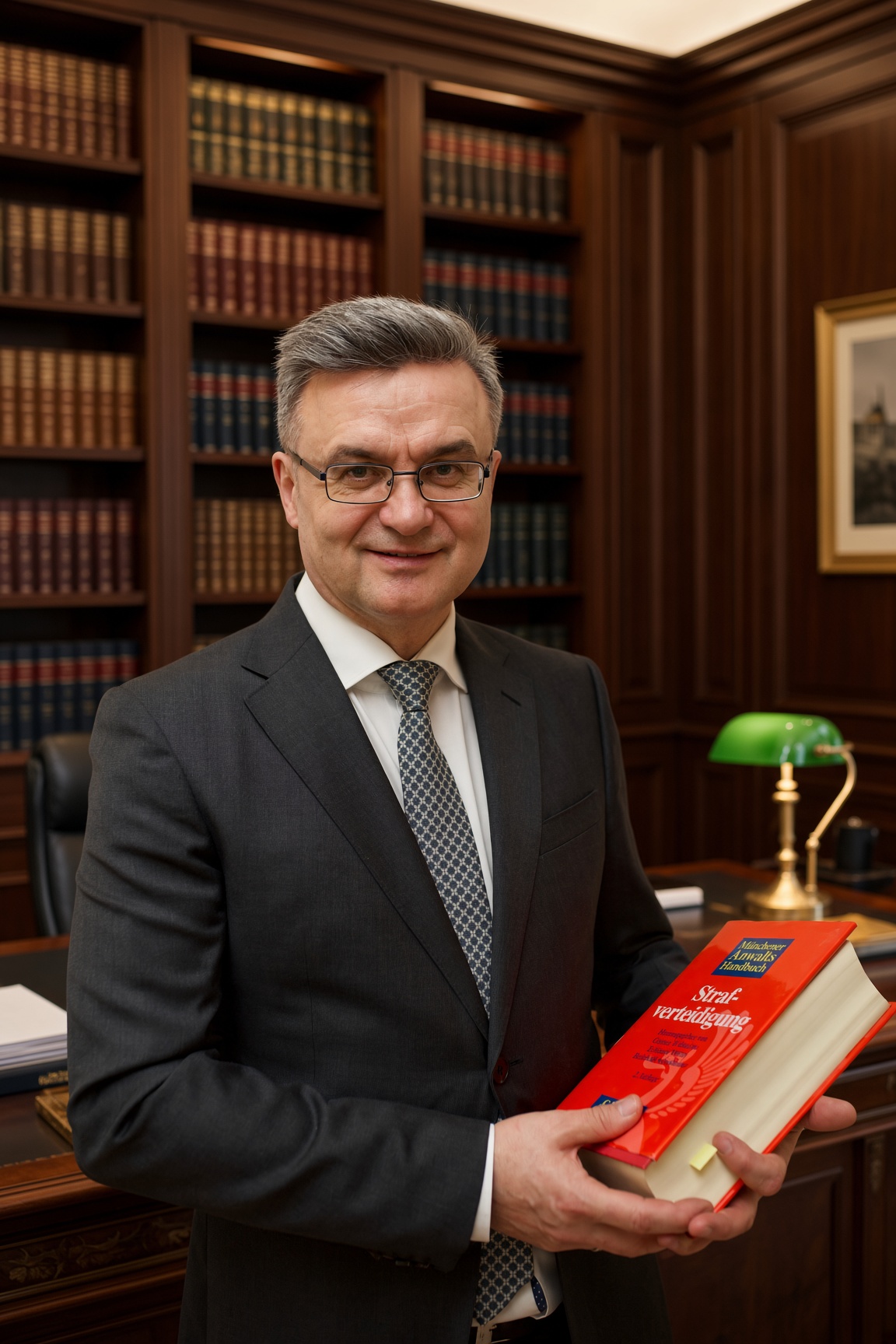
When, a short while later, Bogdan found a summons in his mailbox to appear at the police station for questioning, he had a fair idea of what it would be about. He vaguely sensed that he ought to talk to someone before that conversation. His friends advised him to consult professionals at a law firm. After shaving, Bogdan left home and headed down into the U-Bahn. On his way to meet the attorney, the details of that unfortunate night came back to him. Forty minutes later, Bogdan's brain would be pounding in sheer panic inside his skull — as if that crow from his dream were knocking on his head all over again — as the attorney listed off the relevant sections of the Criminal Code and laid out the prospects for the case.
Alcohol: An Instruction Manual
German law is fairly liberal when it comes to alcohol and subsequently driving a vehicle. Up to 0.3‰ blood alcohol, a driver is considered sober, in the sense that such a dose has no meaningful effect on the ability to drive. Between 0.3‰ and 1.1‰ counts as a state of intoxication involving partial impairment of driving ability — and if a driver at that level of intoxication still handles the vehicle adequately, that's between him and a higher power.
But Bogdan could only envy those who drink in more moderate amounts. In his case — 1.9‰ blood alcohol — §316(2) StGB kicked in, meaning loss of license, up to a year in prison, and a steep fine, assuming there were mitigating circumstances. A mitigating factor here can be that the person driving in that state did so out of mere negligence. Sounds strange? But that's exactly how it works. If you're drinking at some party or gathering — or alone — and are about to get behind the wheel without being able to properly judge how intoxicated you are, and no one warns you against driving, that counts as negligent drunk driving. After all, alcoholic drinks don't list their strength in blood-alcohol percentages.
Bogdan was prepared for a fine and a long driving ban. His mind was seizing up over a different reason entirely. On top of the up to one year in prison possible under the statute Bogdan was charged with, several more years could be added — years he might spend meditating on the architectural features of prison buildings.
As Bogdan told the attorney, he didn't even know whether his driving license was genuine or fake. He had bought it online from Latvia, to avoid the hassle of converting his license in Germany — Ukrainian driving documents aren't valid indefinitely. On hearing this, the attorney informed Bogdan that this amounted to document forgery, punishable by up to five years in prison, with the offense being committed the moment the document is presented. If the police had checked his license and found it fake, the case would have taken a tragic turn — tragic in the sense that the outcome would then be a hundred percent certain, with the fight reduced to arguing over mitigating circumstances alone. Bogdan didn't want to go to prison. And after prison, he didn't want to go back to his home country either.
An Attorney's First Commandment: Help
Our firm's attorneys requested the case file from the police. Sure enough, just as expected, Bogdan was only charged under the drunk-driving statute. There was no mention anywhere in the file of document forgery. Bogdan could breathe a little easier. According to the police records, administrative proceedings had been opened under only one statute — meaning that even if, in the course of preparing for trial, it emerged that his license was fake, that offense could no longer be charged against him. Drunk driving and circulating forged documents (presenting such a document is legally termed "circulation") would have had to be part of the same proceeding — that's the rule. And if the corresponding check and administrative proceeding weren't opened in time as part of the same case, that train had already left the station. Now Bogdan faced, at worst, one year in prison or a fine.
Our attorneys' strategic goal was to keep the matter from going to trial at all. Had Bogdan fallen asleep in the far-right lane, the chances of avoiding any penalty whatsoever would have been quite high. But since Morpheus had visited him in the left lane instead, all effort now had to go toward minimizing whatever penalty our client would face.
Since the key element of the statute Bogdan was charged under is "driving a vehicle while intoxicated," that was precisely the element our defense targeted. There was no point disputing that Bogdan had been heavily intoxicated — the medical test results were clear, and our client never denied that he had been drinking with friends in Neukölln before the drive. But who had actually seen him drive across Berlin? Were there any witnesses? There were none.
Our attorneys therefore petitioned the police to close the case before trial, arguing that there was no way to establish whether the client had actually been driving, or had merely pulled away from a parking spot and stopped in the left lane at the intersection. "Driving," in the legal sense, means movement in a public space. Was an empty street at night such a space? Did covering a distance of three meters even qualify as "driving"? These questions were bound to give the police pause. The letter went on to request that the client be penalized with a fine of ninety daily units and a driving ban of up to 6 months.
Case law in comparable criminal matters typically results in a driving ban of 11–12 months plus a substantial fine. In Bogdan's case, given the arguments presented, the chosen defense strategy, and the timely involvement of an attorney, the court ultimately issued an even more lenient decision than the defense had requested. Bogdan was ordered to pay a fine of six hundred euros and was banned from driving for seven months. By summer, he could technically have gotten his questionable license back — but Bogdan decided to leave it with the police for good and enrolled in driving school instead, so that in the future he could hand over his documents without any anxiety. One can hope that drinking and driving will now be off the table for him entirely.
For our attorneys, this case was yet another confirmation of their professionalism. And one has to wonder — what would have become of Bogdan had he tried to handle his problems with the police entirely on his own?
All rights reserved. Copying or republishing this article requires a link to the original source.